
AI Is Changing Search : Here’s Why Businesses Need to Pay Attention
Not long ago, appearing on the first page of Google was the ultimate goal for businesses looking to grow online. If your website ranked well, you had a better chance of attracting visitors and generating enquiries. And converting those visitors into loyal customers. While that goal hasn’t changed, the way people search for information certainly has.
Today, millions of users are turning to AI-powered platforms such as Google AI Overviews, ChatGPT, Microsoft Copilot, Gemini, and Perplexity instead of relying solely on traditional search engines. Rather than scrolling through pages of search results, people are asking detailed questions and expecting immediate, accurate answers. This shift is changing how businesses gain online visibility and connect with potential customers.
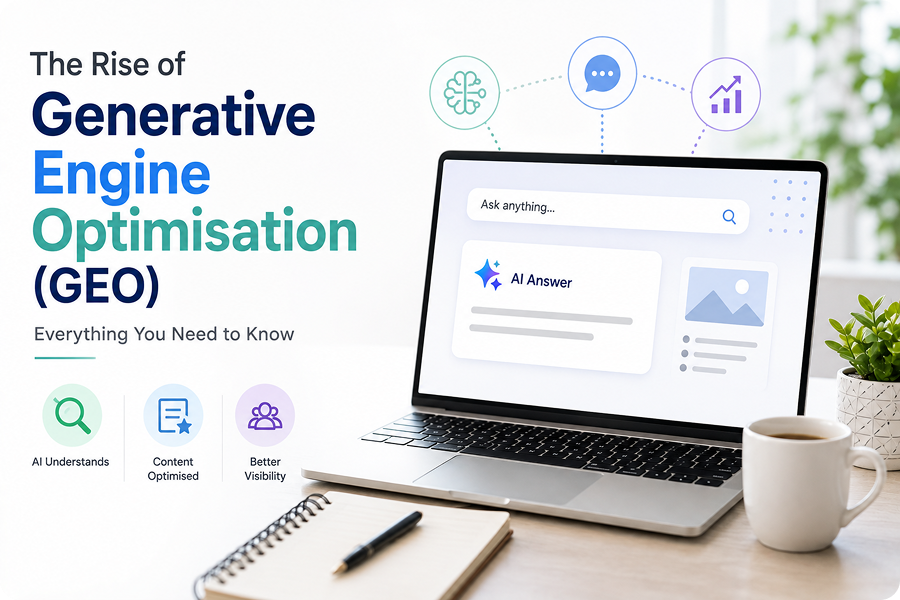
This is where Generative Engine Optimisation (GEO) comes in. While SEO focuses on helping your website rank in search engines. GEO focuses on helping your content become valuable enough for AI platforms to recognise, understand, and reference when generating answers. Businesses that start preparing now will be in a stronger position as AI continues to influence how customers search, compare options, and make purchasing decisions.
What Exactly Is Generative Engine Optimisation?
If you’ve recently heard the term ‘GEO’ and wondered what it means, you’re not alone. It’s one of the fastest-growing topics in digital marketing, yet many business owners are still unfamiliar with it.
Simply put, Generative Engine Optimisation (GEO) is the process of creating high-quality, trustworthy, and well-structured content. That AI-powered search platforms can easily understand and use when answering users’ questions.
Think about how you use AI yourself. Instead of searching for “digital marketing agency Auckland”, you might ask:
“Which digital marketing agency in New Zealand is best for a growing business?”
Rather than showing a list of websites, AI platforms generate a detailed response based on information gathered from reliable online sources.
This means your business isn’t only competing for Google rankings anymore. You’re also competing to become one of the trusted sources AI platforms rely on when providing answers.
Why GEO Is Becoming a Game Changer
The biggest reason GEO is gaining attention is simple—customer behaviour is changing.
People are looking for faster, more personalised answers. They don’t always want to compare ten different websites before making a decision. Instead, they expect AI to summarise the information and provide recommendations they can trust.
For businesses, this creates both a challenge and an opportunity.
If your content is outdated, lacks depth, or doesn’t clearly answer customer questions. AI platforms are less likely to reference it. On the other hand, businesses that consistently publish are informative. Well-researched content has a better chance of becoming recognised as a trusted source.
This is why investing in valuable content has become more important than ever. Businesses that regularly educate their audience are not only strengthening their SEO performance. But also improving their chances of being discovered through AI-powered search experiences. This is where a well-planned content marketing strategy can make a real difference. It’s helping businesses build authority while providing genuine value to their audience.
Is SEO Still Important?
One of the biggest misconceptions about GEO is that SEO is becoming obsolete. The reality is quite the opposite.
SEO remains the foundation of online visibility. Search engines still rely on factors such as website performance, keyword relevance, technical optimisation, backlinks, and user experience when ranking websites.
GEO doesn’t replace these principles; it builds on them.
Think of SEO as helping people find your website. While GEO helps AI understand why your business deserves to be recommended. Businesses with strong SEO foundations are already in a better position because of many of the qualities that improve Google ranking. It is helpful content, website authority, and user experience and also supports AI visibility.
For businesses looking to strengthen their digital presence. Continuing to invest in SEO services remains one of the smartest long-term strategies.
What Makes Content AI-Friendly?
Many people assume AI platforms simply look for keywords, but that’s no longer enough.
AI is designed to understand context, identify expertise, and recognise trustworthy information. Content that performs well usually shares a few important characteristics.
It answers genuine customer questions rather than focusing solely on rankings. It explains topics clearly without unnecessary jargon. It is well organised, factually accurate, and regularly updated to reflect current information.
For example, instead of creating a short page filled with keywords about digital marketing. A business might publish an in-depth guide explaining all features. Like how SEO works, when paid advertising makes sense, and how local businesses can improve online visibility. This type of educational content is far more useful to readers and provides AI systems with richer information to reference.
Businesses that consistently produce this level of content often establish themselves as trusted authorities within their industry.
The Future Belongs to Businesses That Adapt Early
Every major change in digital marketing creates new opportunities. Businesses that embraced mobile-friendly websites, invested in content marketing, or adopted SEO early often gained a significant competitive advantage.
Generative Engine Optimisation represents another important shift.
While AI-powered search is still evolving, one thing is already clear—businesses that focus on expertise, credibility, and genuinely helpful content will be better positioned for the future. Rather than chasing algorithms, successful businesses will focus on answering customer questions, solving real problems, and building trust across every digital touchpoint.
At Kick Start Digital, we believe the future of online visibility isn’t about choosing between SEO and GEO—it’s about combining both to create a stronger digital presence. Businesses that begin adapting today will be better prepared for tomorrow’s search landscape, ensuring they remain visible wherever their customers choose to search.