
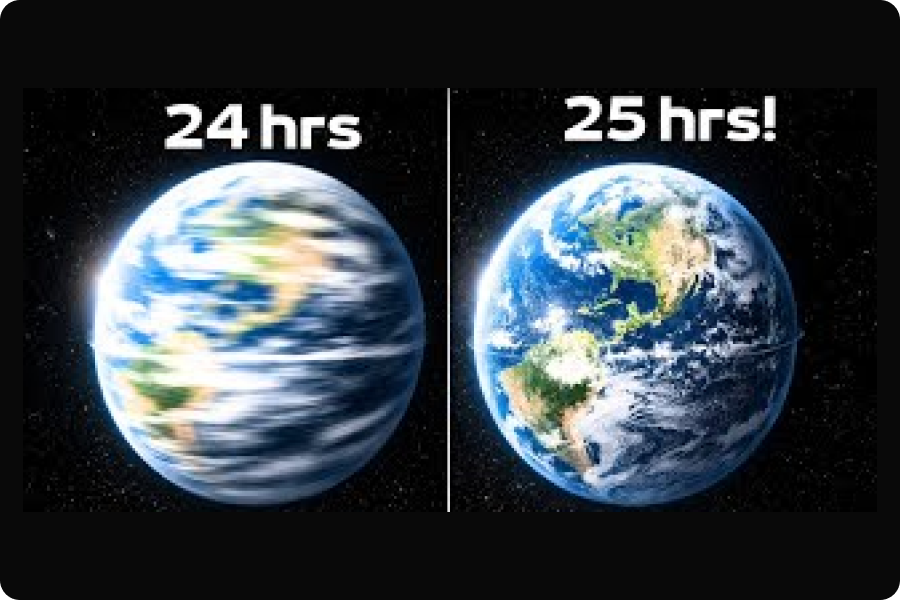
Scientists say Earth’s rotation is gradually slowing down, raising the possibility that future generations could eventually experience 25-hour days. Researchers have linked the long-term shift to the Moon’s gravitational pull, which continues influencing the planet’s rotation over millions of years.
Although the change sounds dramatic, experts stress that the slowdown is extremely gradual and remains unnoticeable in everyday life. Current estimates suggest Earth’s days lengthen by roughly 1.7 milliseconds every century due to tidal friction created by the Moon’s orbit.
Moon’s Gravity Continues to Shape Earth
Scientists explain that the Moon slowly pulls energy from Earth’s rotation through ocean tides. As this process continues, the Moon drifts slightly farther away while Earth’s spin becomes marginally slower over time.
Researchers believe this interaction has shaped Earth’s history for billions of years. Geological studies suggest days on Earth were far shorter in ancient periods, with some estimates indicating the planet once rotated in as little as 10 to 18 hours.
Scientists Track Tiny Changes in Time
Modern technology allows researchers to measure extremely small shifts in Earth’s rotation using atomic clocks, satellite systems, and lunar ranging experiments. These tools help scientists monitor subtle fluctuations that affect global timing systems and navigation technology.
While the broader trend points towards slower rotation, experts have also recorded short-term speed variations in recent years. Some days have become fractions of milliseconds shorter due to changes inside Earth’s core, atmospheric movement, and ocean circulation patterns.
Climate Change Also Influences Rotation
Researchers now say climate change may also contribute to rotational changes. Melting glaciers and rising sea levels redistribute Earth’s mass, slightly affecting how the planet spins. A recent study found the impact from melting polar ice could increase day length at rates not seen for millions of years.
Scientists emphasise that these changes remain tiny and do not pose immediate risks to daily life. However, precise timing adjustments remain important for technologies such as GPS systems, satellites, telecommunications, and spacecraft navigation.
25-Hour Days Remain Far in the Future
Despite growing online discussion around “25-hour days,” researchers say humans will not experience the shift anytime soon. Most scientific projections place a true 25-hour day roughly 200 million years into the future if current long-term trends continue.
The research, nevertheless, offers a fascinating reminder that Earth remains a constantly evolving planet influenced by complex interactions between oceans, atmosphere, gravity, and space.
For more science developments, space discoveries, and global research updates, readers can explore Find New Zealand for ongoing coverage and insights from around the world.