
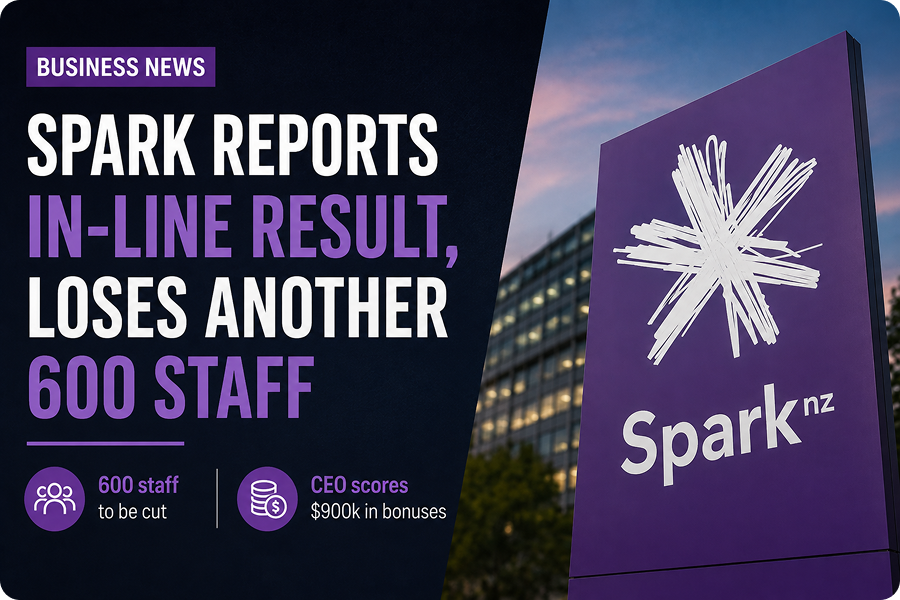
Spark New Zealand has reported its latest financial performance amid another period of major change for the telecommunications company. The business has continued reshaping its operations, with a further reduction in staff numbers forming part of its effort to lower costs and concentrate on its core connectivity services. Spark’s investor centre lists its FY26 results for 20 August 2026.
The latest developments come after a difficult period for the company and the wider technology sector. Spark has been adjusting to softer customer spending, changing demand and pressure on parts of its business. Its previous restructuring had already reduced its workforce substantially, while management outlined a strategy centred more strongly on connectivity.
Workforce Changes Reflect a Wider Business Reset
Staff reductions have become an important part of Spark’s cost-management programme. The company previously reported that its workforce had fallen by more than 1,200 people, with about 4,043 employees remaining at the end of its 2025 financial year. Spark said the changes formed part of a broader transformation aimed at improving performance and simplifying the business.
For employees, continued restructuring can create uncertainty. For the company, however, reducing operating costs can provide greater flexibility while it directs resources towards areas it considers more important for future growth. The challenge will be balancing efficiency with the skills and expertise needed to deliver reliable services to customers.
Connectivity Remains at the Centre
Spark has increasingly placed its core connectivity operations at the centre of its strategy. Mobile and broadband services remain important parts of the business, while other areas have faced tougher trading conditions.
The company previously reported broadband revenue of $608 million, while cloud revenue increased to $235 million. Its IT services division, however, recorded a decline in revenue, while the data centre business continued to grow.
This shift suggests Spark is taking a more focused approach to its future. Rather than spreading investment across a wide range of digital services, the company is looking to strengthen the parts of the operation that can provide more predictable returns.
CEO Remuneration Draws Attention
Executive remuneration is also likely to attract interest as Spark reports its latest performance. CEO Jolie Hodson remains at the centre of the company’s leadership as it carries out the transformation.
Debate around executive pay often becomes stronger when a company is reducing its workforce. Shareholders and employees may look closely at how leadership remuneration is linked to financial results, business performance, and wider organisational changes.
Spark’s investor information identifies Hodson as chief executive and outlines the company’s broader leadership structure and financial reporting.
What the Changes Could Mean for Spark
Spark’s next stage will depend on whether its tighter strategy can improve performance while maintaining customer service and investment in its network. The telecommunications market continues to change rapidly, with customers expecting reliable connectivity alongside competitive pricing and better digital experiences.
The company will also need to manage the impact of workforce reductions carefully. Maintaining specialist knowledge and supporting remaining employees will be important as Spark continues implementing its long-term plans.
We hope this article helped you understand the wider business changes taking place at Spark and what they could mean for employees, customers, and the telecommunications sector. Stay with Find NZ for more business stories, company developments, economic insights, and useful information that matters to Kiwis. Keep exploring Find NZ to gain knowledge, discover new perspectives, and stay connected with important developments in New Zealand.