
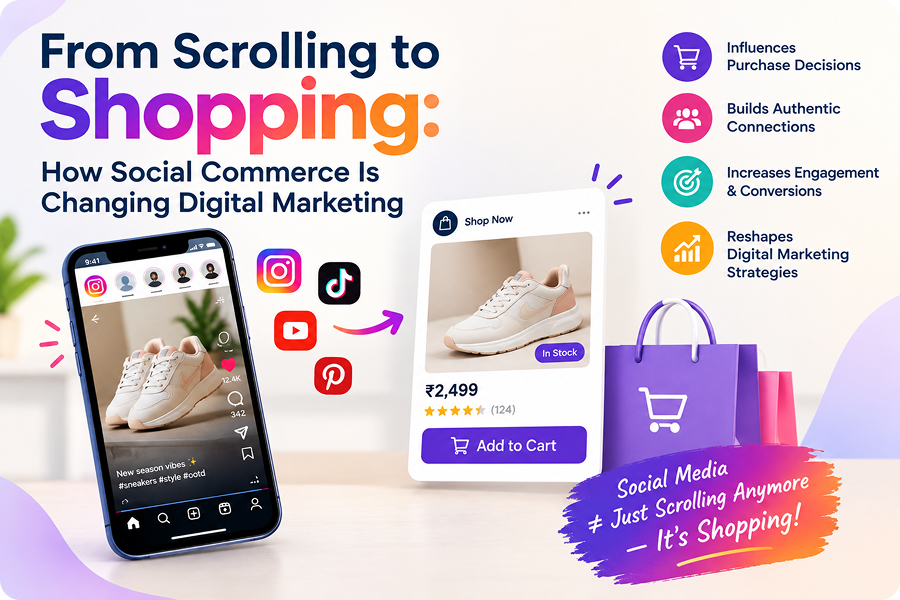
Social media was once mainly a place to connect with friends, watch videos, and discover new ideas. Today, it has become part of the shopping journey. People can discover a product while scrolling, learn about it through a creator, check reviews, visit a product page and make a purchase without leaving the platform.
This change has created a powerful opportunity for businesses: social commerce.
Social commerce combines social media and online shopping, allowing businesses to promote products, engage with customers and support purchases through social platforms. As consumers spend more time discovering products through social content, brands are looking beyond traditional e-commerce websites to reach customers where their attention already exists.
For digital marketers, this means the path from scrolling to shopping is becoming shorter.
What Is Social Commerce?
Social commerce is the use of social media platforms to promote, discover, and purchase products or services. It goes beyond traditional social media marketing because the shopping experience can become part of the social experience itself.
A customer might see a product in a short video, click a product tag, read comments, explore reviews, and continue towards a purchase. Instead of moving from social media to a completely separate shopping journey, social commerce connects discovery, consideration and purchasing more closely together.
This makes social commerce different from simply posting a product advertisement on Facebook or Instagram. The focus is on creating a smoother connection between social media engagement and e-commerce.
Why Social Commerce Is Growing
Consumers are increasingly discovering brands through social platforms. Search engines are no longer the only place where people research products, services and brands. Social media has become an important discovery channel, particularly for visually driven categories such as fashion, beauty, food, travel, home décor and lifestyle products.
Short-form videos have accelerated this behaviour. A useful demonstration, product review, or entertaining video can introduce a product to thousands of potential customers without looking like a traditional advertisement.
This creates a valuable opportunity for brands. Instead of waiting for customers to search for a product, businesses can place their products within the content customers are already consuming.
From Product Discovery to Purchase
Traditional ecommerce often starts with a search. A customer knows what they want, enters a search query, compares options and eventually makes a purchase.
Social commerce can work differently.
A customer may not be looking for anything at all. They could simply be scrolling through their social feed when a product catches their attention. An engaging video can create interest, demonstrate the product and encourage the person to learn more.
That makes product discovery one of the most important parts of social commerce.
The opportunity for marketers is to create content that makes people stop scrolling.
A strong product image can attract attention, but useful demonstrations, before-and-after content, customer experiences, tutorials and authentic creator content can give people a reason to continue watching.
Social Media Is Becoming a Shopping Search Engine
People increasingly use social platforms to discover brands, products, restaurants, destinations and services. This means marketers need to think beyond traditional search engine optimisation.
Social media optimisation is becoming an important part of online visibility. Captions, keywords, hashtags, product descriptions, videos and creator content can all influence whether people discover a brand.
This does not mean SEO is becoming less important. Instead, search behaviour is becoming more fragmented.
A customer might search Google for a product, check TikTok for demonstrations, visit Instagram to see how people use it and then purchase through an ecommerce website.
Successful digital marketing strategies need to recognise this connected customer journey.
The Power of Short-Form Video
Short-form video has become one of the strongest content formats for social commerce because it can combine entertainment, education and product discovery.
A business selling skincare products, for example, could create a short video demonstrating how a product is used. A clothing brand could show different ways to style one item. A food business could demonstrate how a product is prepared.
The important point is that the content should provide value rather than simply saying, “Buy this.”
People are more likely to engage when content answers a question, solves a problem or gives them a reason to keep watching.
For marketers, this changes the role of social media content. The goal is no longer just to collect likes. The content needs to help customers move from attention to interest and from interest to action.
Influencer Marketing Is Changing the Buying Journey
Influencer marketing has become closely connected with social commerce because creators can introduce products through content that feels more personal than traditional advertising.
A creator might demonstrate a product, explain how they use it or share their experience with an audience that already trusts their recommendations.
However, successful influencer marketing is not simply about choosing someone with a large follower count. The audience needs to be relevant to the product, and the creator’s content should fit naturally with the brand.
A smaller creator with a highly engaged niche audience can sometimes provide a different type of value from a celebrity with millions of followers.
This is why businesses should consider audience relevance, engagement, content quality and brand fit when developing an influencer marketing strategy.
Reviews and User-Generated Content Build Trust
One of the biggest challenges in online shopping is uncertainty.
Customers cannot physically touch a product or speak to a salesperson before purchasing. Reviews, demonstrations and user-generated content can help reduce that uncertainty.
A customer posting a genuine experience with a product can provide information that a polished advertisement may not communicate.
User-generated content can also make a brand feel more authentic. Businesses can encourage customers to share experiences, reviews, photos and videos, then use appropriate customer-generated content across their social media and marketing channels.
This creates a cycle where existing customers help potential customers make purchasing decisions.
Social Commerce Makes the Customer Journey More Interactive
Traditional advertising often creates a one-way conversation. A brand delivers a message and hopes the audience responds.
Social commerce creates more opportunities for interaction.
Customers can comment on products, ask questions, share content, participate in live shopping events, and communicate directly with brands. Businesses can use these interactions to understand what customers actually want.
A comment such as “Does this come in another size?” is not just a customer question. It can also reveal a potential content opportunity.
If the same question appears repeatedly, the business could create a product guide, FAQ, video, or social post addressing it.
This is where social media marketing and customer research can work together.
Live Shopping Creates a Digital Store front
Live shopping takes social commerce a step further by combining video, interaction, and purchasing in real time.
During a live session, a creator or brand representative can demonstrate products, answer questions, and encourage viewers to explore products while they are watching.
The experience is closer to speaking with a salesperson than simply viewing a static product page.
For brands, live shopping can create urgency and interaction. For customers, it can provide an opportunity to ask questions before making a purchasing decision.
Personalisation Can Make Social Commerce More Relevant
Social platforms collect a large amount of information about user interests and behaviour. This allows businesses to deliver more relevant content and advertising to specific audiences.
However, personalisation needs to be handled carefully.
Customers want relevant experiences, but they also expect businesses to respect privacy. Modern social commerce strategies therefore need to balance personalisation with transparent data practices.
Businesses should focus on creating value rather than using personalisation simply to increase the amount of advertising customers see.
Social Commerce and Ecommerce Should Work Together
Social commerce does not necessarily replace an e-commerce website.
Instead, the two can support each other.
Social media can introduce products, generate interest and encourage discovery, while an e-commerce website can provide detailed product information, payment options, customer accounts and other parts of the purchasing experience.
This creates an interconnected digital marketing strategy.
For example, a customer may discover a product through Instagram, watch a demonstration on TikTok, search for reviews on Google and finally purchase through the company’s website.
Every stage provides an opportunity for the brand to deliver useful information.
How Businesses Can Build a Social Commerce Strategy
A successful social commerce strategy starts with understanding the target audience. Businesses need to know which platforms their customers use, what type of content they consume and what influences their purchasing decisions.
The next step is creating content designed for discovery. Instead of turning every post into an advertisement, brands can mix product demonstrations, educational content, customer stories, behind-the-scenes content and useful tips.
Businesses should also make the purchasing journey as simple as possible. If customers have to move through several confusing pages before finding the product, interest can quickly disappear.
The strongest social commerce strategies connect content, community and commerce.
Measure More Than Likes
Social media engagement is useful, but likes and follower numbers do not tell the complete story.
Businesses should also examine website visits, product views, add-to-cart activity, conversions, sales, customer acquisition costs and return on advertising spend.
These metrics help marketers understand whether social content is contributing to actual business outcomes.
A post with fewer likes could still generate more sales than a highly popular post. That is why social commerce performance should be measured against meaningful business objectives rather than vanity metrics alone.
The Future of Social Commerce
Social commerce is changing the relationship between content and ecommerce. A social post is no longer necessarily the end of a marketing campaign. It can become the beginning of a shopping journey.
The businesses that understand this shift can create content that does more than attract attention. They can use social media to educate customers, build trust, encourage product discovery and make purchasing easier.
The future of digital marketing will not be about choosing between social media and e-commerce. It will be about connecting them.
From the first scroll to the final purchase, every interaction can become part of the customer journey. Brands that make that journey useful, engaging and easy to navigate can turn social attention into meaningful business opportunities.
Make Your Brand Easier to Discover Online
Social commerce is only one part of a successful digital marketing strategy. Strong online visibility also depends on having the right content, SEO, website experience and customer-focused marketing approach.
If you are looking to improve your business’s visibility across New Zealand, Find New Zealand can help customers discover local businesses, products and services through a dedicated business discovery platform.
For businesses that want to strengthen their broader online presence, Kickstart Digital provides digital marketing and SEO solutions designed to help brands improve visibility, reach relevant audiences and build sustainable online growth.
Explore Find New Zealand to discover local businesses and services, and connect with Kickstart Digital when you’re ready to take your digital marketing strategy further.