
Why Prompt Engineering Matters in Modern Marketing
Marketing has always depended on asking the right questions. Whether a business is researching its customers, developing campaign ideas, writing content, or analysing performance, the quality of the input often influences the quality of the outcome.
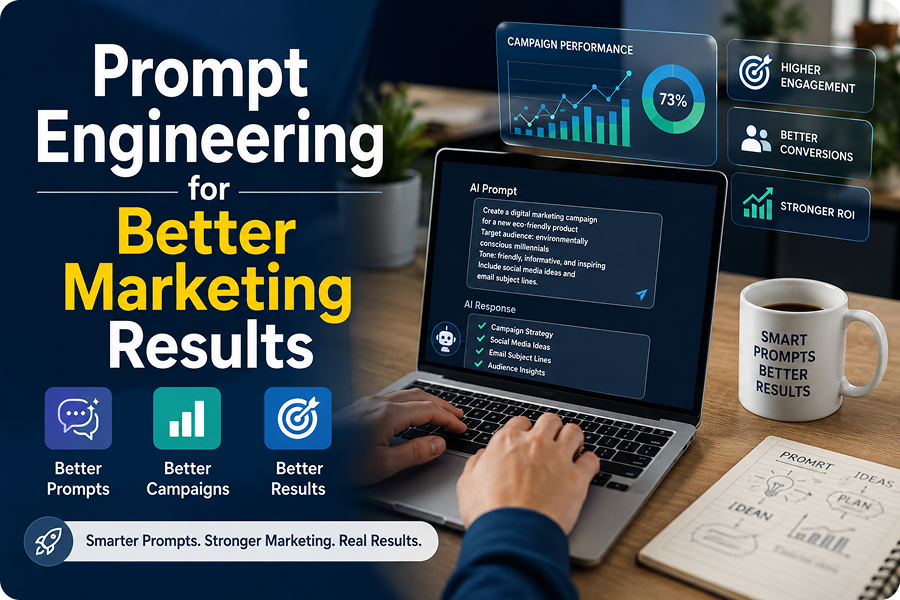
With AI now becoming part of everyday marketing workflows, this principle has taken on a new importance. Prompt engineering is the practice of creating clear, specific instructions for AI tools so they can produce more useful and relevant results. For marketers, it is not simply about writing better prompts. It is about using AI more strategically to save time, improve efficiency, support decision-making, and create stronger marketing outcomes.
Businesses that understand how to use prompt engineering effectively can turn AI from a basic content-generation tool into a valuable marketing support system.
What Is Prompt Engineering?
Prompt engineering involves designing instructions that clearly communicate what you want an AI system to do. A vague request may produce a generic response, while a detailed prompt can provide the context, audience, objective, format, and constraints needed to generate a more useful result.
For example, asking an AI tool to “write a marketing post” provides very little direction. A stronger prompt could specify the target audience, campaign objective, brand voice, key message, platform, word count, and desired call to action.
The difference is important because effective prompting helps marketers spend less time correcting irrelevant outputs and more time refining ideas that support their actual business goals.
Better Prompts Can Improve Marketing Efficiency
One of the biggest benefits of prompt engineering is efficiency. Marketing teams often spend significant amounts of time researching topics, generating ideas, preparing drafts, analysing information, and creating variations of campaigns.
Well-structured prompts can help accelerate these repetitive tasks. Marketers can use AI to generate initial content ideas, organise research, develop campaign concepts, summarise information, create customer personas, and explore different messaging approaches.
This does not mean handing marketing decisions entirely to AI. Instead, it allows teams to reduce time spent on routine work and focus more attention on strategy, creativity, and customer relationships.
Prompt Engineering Supports Better Content Marketing
Content marketing requires consistency, relevance, and a strong understanding of the target audience. AI can support each of these areas when marketers provide the right instructions.
A carefully designed prompt can tell an AI tool who the content is for, what problem it should address, which stage of the buying journey it supports, and what action the reader should take.
This can help marketers develop more relevant blog ideas, social media content, email campaigns, landing page concepts, and other marketing materials.
However, effective content still requires human oversight. AI-generated material should be reviewed for accuracy, originality, brand alignment, and genuine customer value before publication.
Customer Insights Become More Actionable
Understanding customers is at the heart of successful marketing. Businesses collect information from surveys, reviews, website analytics, customer enquiries, sales conversations, and campaign results.
Prompt engineering can help marketers organise and analyse this information more effectively. For example, a business could use AI to identify recurring customer concerns, group feedback into themes, or highlight common objections found in customer enquiries.
These insights can then inform content strategies, product messaging, advertising campaigns, and customer experience improvements.
The value comes not simply from asking AI to analyse data, but from giving it a clear objective and relevant context.
Personalisation Without Increasing Workload
Customers increasingly expect marketing messages that feel relevant to their needs. However, creating personalised content manually for every audience segment can require considerable time and resources.
Strategic prompting can help businesses develop variations of marketing messages for different customer groups, industries, locations, or stages of the buying journey.
For example, the same service could require different messaging for a first-time visitor, an existing customer, and a prospect who has already requested a quote. Prompt engineering can help marketers explore these variations efficiently while maintaining consistent brand messaging.
Stronger Campaign Planning
Prompt engineering can also support the planning stage of a marketing campaign.
Instead of asking AI for a complete campaign immediately, marketers can provide information about the business objective, target audience, available channels, budget considerations, competitors, customer pain points, and expected outcomes.
AI can then help identify potential campaign angles, content themes, customer objections, and messaging opportunities.
This provides marketers with more ideas to evaluate before committing resources. Human expertise remains essential for deciding which recommendations are realistic, appropriate, and aligned with the business strategy.
Better SEO and Search Visibility
Prompt engineering can also support modern SEO and search marketing workflows. Marketers can use carefully structured prompts to explore search intent, identify content gaps, develop topic clusters, create content briefs, and review existing material.
The goal should not be to produce large amounts of AI-generated content simply to target keywords. Instead, prompts should encourage useful, original, customer-focused content that addresses genuine search needs.
As search continues to evolve through AI-powered experiences, businesses need content that demonstrates expertise and provides clear answers. Strategic use of AI can support this process without replacing the fundamentals of good SEO.
Measuring Marketing Performance More Effectively
Marketing decisions should be supported by data. Businesses often have access to large amounts of information from advertising platforms, website analytics, CRM systems, email campaigns, and social media.
Prompt engineering can help marketers ask more focused questions about this information. Rather than simply requesting a summary, marketers can ask AI to identify unusual changes, compare campaign performance, highlight potential weaknesses, or suggest questions for further investigation.
This can make performance analysis more accessible and help teams identify areas that deserve closer attention.
The Business Benefits Go Beyond Saving Time
The value of prompt engineering is not limited to faster content production. When implemented properly, it can support broader business outcomes.
Marketing teams can improve workflow efficiency, explore more ideas, personalise communication, analyse information faster, and make better-informed decisions. Smaller businesses can also use these capabilities to compete more effectively when they have limited marketing resources.
The key is to treat prompt engineering as a strategic skill rather than a shortcut for producing more content.
Human Expertise Still Matters
AI can process information and generate responses quickly, but it does not replace human judgement. Marketing involves creativity, empathy, brand understanding, commercial awareness, and knowledge of customer behaviour.
A successful AI-assisted marketing workflow therefore combines technology with human expertise. Marketers should review outputs, verify important information, protect confidential data, and ensure every piece of content reflects the brand’s values and objectives.
The strongest results come from collaboration between marketers and AI—not from allowing technology to make every decision.
How Businesses Can Get More From Prompt Engineering
Businesses do not need complicated systems to start benefiting from prompt engineering. They can begin by creating prompts around specific marketing tasks and gradually improve them based on the quality of the results.
A useful prompt should provide enough context for the AI to understand the task. Including the audience, objective, relevant background information, preferred format, tone, limitations, and expected outcome can significantly improve the usefulness of the response.
Over time, businesses can develop reusable prompt frameworks for content planning, campaign development, customer research, SEO, performance analysis, and other recurring marketing activities.
Final Thoughts
Prompt engineering is becoming an increasingly valuable skill as AI becomes more deeply integrated into digital marketing. The businesses that benefit most will not necessarily be those using the most AI tools, but those that know how to use them with purpose.
By providing better instructions, marketers can improve efficiency, develop stronger ideas, understand customers more effectively, and support better marketing decisions. Combined with human creativity and strategic expertise, prompt engineering can become a practical advantage for businesses looking to achieve better marketing results without unnecessarily increasing their workload.
For businesses across New Zealand looking to improve their visibility and connect with customers, Find New Zealand provides a platform for discovering reputable local businesses and services. For organisations that want to strengthen their digital marketing strategy, Kickstart Digital can support growth through SEO, content marketing, performance marketing, Google Ads, website optimisation, and data-driven digital strategies.
The future of marketing will not simply belong to businesses that use AI. It will belong to businesses that know how to use AI effectively.